
 By Henry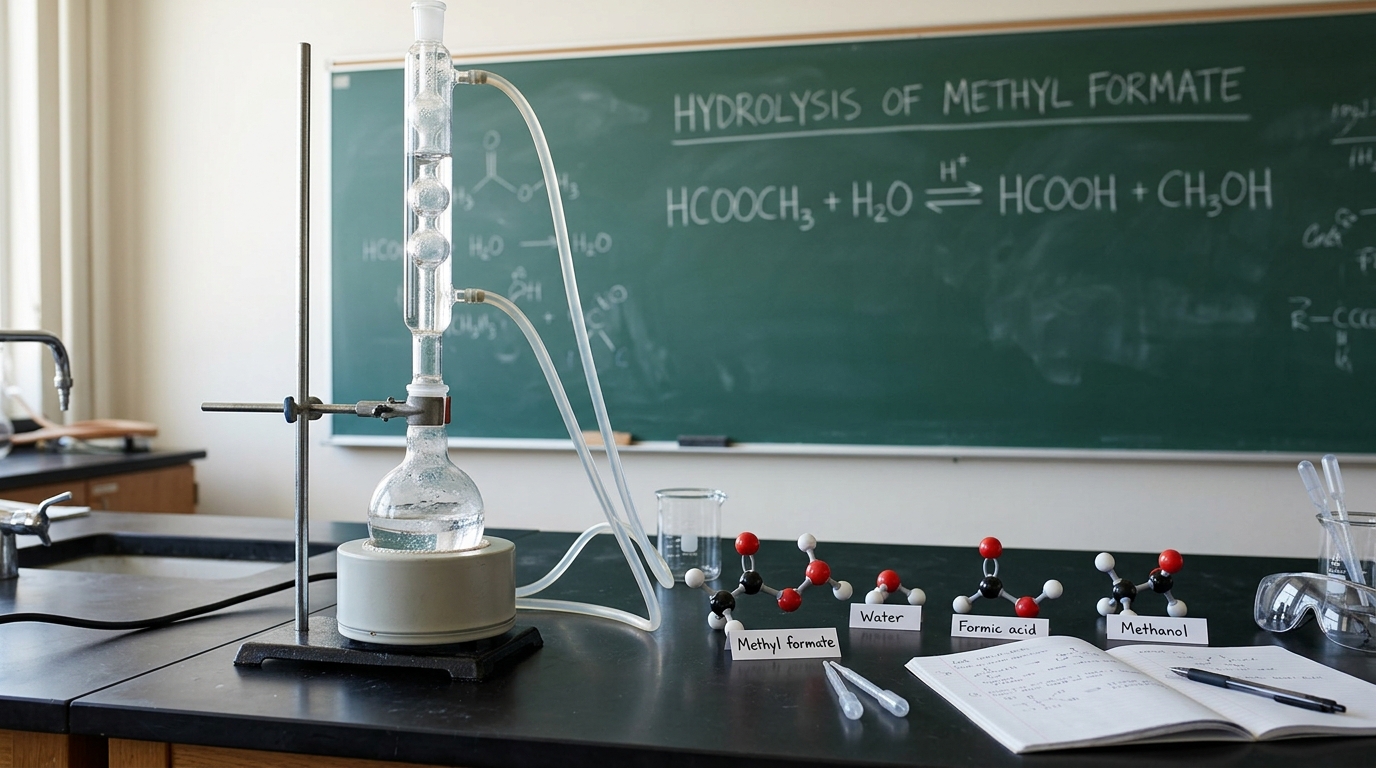
Have you ever typed a chemical formula into a search bar only to get nothing useful back? Or maybe you stared at a scribbled note from class and wondered if the letters even made sense together. That is exactly the situation with hcooch ch2 h2o. Students, teachers, and even researchers sometimes run into strings of letters and numbers that look almost right yet refuse to match any standard entry in a textbook. The phrase pops up in homework questions, forum posts, and hurried exam notes. So what is going on here?
In short, hcooch ch2 h2o is not a valid chemical formula. It is a malformed expression that almost certainly points to a common organic reaction: the hydrolysis of methyl formate. Once you pull the pieces apart and put them back together the right way, the chemistry becomes clear and useful. This article walks through every part of that puzzle in plain language. You will see why the original string fails, what each fragment probably meant, and how the real reaction works. By the end you will be able to spot similar notation mistakes and write the correct equations yourself.
Why Chemical Notation Sometimes Goes Sideways
Organic chemistry lives and dies by precise notation. A single misplaced letter or missing subscript can turn a familiar ester into gibberish. Students often write formulas the way they hear them spoken in lecture. Teachers sometimes scribble quickly on a board. Search engines then index those imperfect strings, and the next person who types the same letters expects a clean answer. The result is a small but steady stream of searches for things like hcooch ch2 h2o.
The good news is that these broken strings usually contain recognizable pieces. HCOO is the formate group. CH2 is almost always a mistyped methyl or methylene fragment. H2O is simply water. Put them side by side and the intended reaction jumps out: an ester meeting water under acid conditions. That reaction is classic first-year organic chemistry, and it appears in everything from industrial processes to the way certain fragrances break down in moist air.
Breaking Down the Individual Pieces of hcooch ch2 h2o
Let us look at each fragment the way a detective would examine evidence.
HCOO sits at the front. In proper notation this is the formate anion or the formyl portion of an ester. Formic acid itself is HCOOH. When it forms an ester the acidic hydrogen is replaced by an alkyl group, giving HCOOR. So the letters HCOO already signal a one-carbon carboxylic acid derivative.
Next comes CH2. In organic formulas CH2 normally means a methylene group, the -CH2- unit that appears in longer chains. Yet in the context of simple esters the methyl group is written CH3. A hurried note or a keyboard slip easily turns the 3 into a 2. Many students also confuse the numbering of carbons when they first meet esters, so the error is common.
Finally there is H2O. That one needs no translation. Water is the reactant that attacks the ester in hydrolysis. The presence of water next to an ester fragment is the strongest clue that the intended topic is ester hydrolysis rather than, say, an addition reaction or a polymerization.
Taken together the string is trying to say “methyl formate plus water.” The correct molecular formula for methyl formate is HCOOCH3 or HCO2CH3. The hydrolysis equation is therefore:
HCOOCH3 + H2O → HCOOH + CH3OH
That single corrected equation is the heart of the matter.
The Most Likely Intended Reaction: Ester Hydrolysis of Methyl Formate
Ester hydrolysis is the reaction that converts an ester into a carboxylic acid and an alcohol by the addition of water. When the ester is methyl formate the products are formic acid and methanol. The process is reversible, which means the same conditions that break the ester can also rebuild it. Chemists therefore control the direction by adjusting concentration, temperature, and the presence of a catalyst.
Methyl formate is the simplest ester that contains a formate group. It is a colorless liquid with a pleasant, ethereal odor. Industry uses it as a blowing agent for foams, a solvent for cellulose, and a precursor to formamide and other chemicals. In the laboratory it serves as a convenient example because both the starting material and the products are easy to handle and identify.
Under acidic conditions the reaction proceeds smoothly. A catalytic amount of sulfuric acid or hydrochloric acid is enough to get things moving. The acid protonates the carbonyl oxygen, making the carbon more attractive to water. Once water adds, a series of proton transfers and the departure of methanol complete the transformation. The net result is formic acid and methanol, exactly the molecules that appear when you rewrite hcooch ch2 h2o correctly.
How Acid-Catalyzed Ester Hydrolysis Actually Works
Understanding the mechanism helps you predict what will happen with other esters and prevents the same notation mistakes in the future. Here is the sequence in everyday language.
First the acid catalyst donates a proton to the carbonyl oxygen of the ester. The oxygen now carries a positive charge, and the carbon of the carbonyl becomes more electron-deficient. Water, which is a weak nucleophile under neutral conditions, can now attack that carbon. The addition creates a tetrahedral intermediate: a carbon attached to four groups (the original alkoxy group, the hydroxyl from water, the original hydrogen or alkyl of the acid portion, and the protonated oxygen).
Next a proton transfers from the newly added water oxygen to the alkoxy oxygen. This sets up the alkoxy group as a good leaving group. When that group departs it leaves behind a protonated carboxylic acid. A final deprotonation restores the neutral carboxylic acid and regenerates the acid catalyst.
Every step is reversible. If you start with the carboxylic acid and the alcohol and remove water, the equilibrium shifts back toward the ester. That is why the reaction is often written with a double arrow. In practice chemists drive hydrolysis to completion by using excess water or by removing the alcohol as it forms.
Products of the Reaction and Why They Matter
The two products, formic acid and methanol, each have their own stories.
Formic acid is the simplest carboxylic acid. It occurs naturally in ant venom and in the stings of some bees. In industry it serves as a preservative, a pH adjuster in animal feed, and a reagent for the production of leather and textiles. Its small size and relatively high acidity make it useful in organic synthesis as well.
Methanol is the simplest alcohol. It is a major industrial chemical produced from synthesis gas and used to make formaldehyde, acetic acid, and a host of other compounds. It is also a candidate fuel and a solvent. Because methanol is toxic, laboratory work with methyl formate hydrolysis requires ordinary care: good ventilation and avoidance of ingestion or prolonged skin contact.
Seeing both products emerge from a single, clean reaction illustrates a broader principle. Esters are stored forms of carboxylic acids and alcohols. Nature uses the same idea when it builds fats and oils. Hydrolysis (or the enzyme-catalyzed version called saponification when base is used) releases the free acids and alcohols that living systems need.
Common Mistakes That Produce Strings Like hcooch ch2 h2o
Several habits lead to malformed formulas.
Students sometimes write the ester as HCOOCH instead of HCOOCH3, dropping the final hydrogen count. Others hear “methyl” and write CH2 because they are thinking of the divalent methylene unit rather than the monovalent methyl group. A few mix the order of atoms and produce HCOOC H2 or similar variants. Handwriting can turn a subscript 3 into something that looks like a 2 when the note is later typed.
Another frequent source of confusion is the difference between molecular formulas and structural formulas. Methyl formate can be written HCOOCH3, HCO2CH3, or even as a condensed structure showing the carbonyl. When someone tries to force a structural idea into a linear string without subscripts or parentheses, the result can look a lot like hcooch ch2 h2o.
Search engines do not correct chemical notation the way a spell-checker corrects ordinary English. They simply return pages that contain the exact string. That is why an article like this one is useful: it intercepts the broken query and supplies the correct chemistry.
Proper Notation and IUPAC Names
Once you know the intended molecules, writing them correctly becomes straightforward.
Methyl formate is the common name. The IUPAC name is methyl methanoate. Formic acid is methanoic acid. Methanol is methanol (or methyl alcohol). The balanced equation using molecular formulas is:
HCOOCH3 + H2O ⇌ HCOOH + CH3OH
If you prefer structural emphasis you can write:
HCO2CH3 + H2O ⇌ HCO2H + CH3OH
Both versions are acceptable in most classroom settings. The important point is that every atom is accounted for and the stoichiometry is clear.
Comparing Ester Hydrolysis with Esterification
The reverse of hydrolysis is esterification. When formic acid and methanol are heated with an acid catalyst and water is removed, methyl formate forms. The two reactions share the same tetrahedral intermediate and the same catalyst. The only difference is the direction of the equilibrium.
A simple table helps keep the ideas straight.
Reaction | Starting Materials | Products | Typical Conditions
Hydrolysis | Methyl formate + water | Formic acid + methanol | Excess water, acid catalyst, moderate heat
Esterification | Formic acid + methanol | Methyl formate + water | Excess alcohol or water removal, acid catalyst, heat
Notice that the same four molecules appear in both rows. Only the arrow direction and the practical details change. This symmetry is one reason organic chemists spend so much time on carbonyl chemistry: a small set of principles covers a large number of transformations.
Real-World Contexts Where the Chemistry Appears
Methyl formate hydrolysis is not only a textbook exercise. In the manufacture of formic acid, methyl formate is sometimes an intermediate. The compound is also studied in atmospheric chemistry because it can form from the oxidation of methanol and then hydrolyze in cloud droplets. Fragrance chemists pay attention to the hydrolysis rates of formate esters because the release of formic acid can affect scent profiles over time.
In the teaching laboratory the reaction offers a convenient way to practice reflux, distillation, and simple qualitative tests. Students can confirm the presence of formic acid by its reducing properties or by the formation of a silver mirror under Tollens conditions (with appropriate safety precautions). Methanol can be detected by its characteristic odor or by conversion to a solid derivative.
Tips for Students Who Encounter Odd Formulas
When you meet a string that does not match any entry in your textbook, try these steps.
- Separate the fragments at every capital letter or obvious functional-group boundary.
- Ask whether each fragment corresponds to a known group: carboxyl, alkyl, hydroxyl, etc.
- Look for the presence of water or alcohol next to a carbonyl-containing piece; that combination almost always signals hydrolysis or esterification.
- Rewrite the fragments with correct subscripts and check atom balance.
- Search for the corrected formula rather than the original string.
These habits turn a moment of confusion into a chance to reinforce core knowledge.
Five Quick Takeaways
- hcooch ch2 h2o is not a valid formula; it is a common miswriting of methyl formate plus water.
- The intended reaction is the acid-catalyzed hydrolysis of methyl formate to formic acid and methanol.
- The mechanism proceeds through a protonated carbonyl and a tetrahedral intermediate.
- The reaction is reversible; conditions decide whether hydrolysis or esterification wins.
- Clean notation prevents search failures and exam mistakes; always count the hydrogens on alkyl groups.
What to Do Next
Open your notebook or a blank document and write the correct equation three times: once with molecular formulas, once with condensed structural formulas, and once showing the acid catalyst explicitly. Then try the same exercise with ethyl acetate or any other simple ester. The more you practice converting broken strings into balanced equations, the faster you will recognize the underlying chemistry when it appears again.
If you teach the topic, consider giving students a short list of deliberately malformed formulas and asking them to decode each one. The exercise builds both chemical intuition and attention to detail.
Chemistry rewards precision, yet it also rewards curiosity. The next time a strange combination of letters and numbers appears on your screen or your page, treat it as an invitation rather than a barrier. Pull the pieces apart, name them correctly, and the reaction will usually reveal itself.
FAQs
What does hcooch ch2 h2o mean in chemistry?
It is a non-standard, incomplete string that students and searchers often type when they mean methyl formate plus water. The letters HCOO point to the formate group, CH2 is almost always a mistyped methyl (CH3), and H2O is water. Together they point to the acid-catalyzed hydrolysis of methyl formate.
Is hcooch ch2 h2o a valid chemical formula?
No. It lacks proper subscripts, atom counts, and spacing. The correct formula for the ester is HCOOCH3 (or HCO2CH3). Adding water gives the balanced equation HCOOCH3 + H2O ⇌ HCOOH + CH3OH.
What are the products of the hcooch ch2 h2o reaction?
When the intended reaction occurs, methyl formate reacts with water to yield formic acid (HCOOH) and methanol (CH3OH). Both products are simple, well-known molecules used in industry and the teaching lab.
Why is hcooch ch2 h2o written incorrectly so often?
People drop the final hydrogen on the methyl group, confuse CH2 with CH3, or copy hurried board notes without checking atom balance. Search engines then index the broken string, so the same error keeps appearing.
What is the reaction mechanism behind hcooch ch2 h2o?
Under acid catalysis the carbonyl oxygen of methyl formate is protonated first. Water then attacks the carbon, forming a tetrahedral intermediate. After proton transfers, methanol leaves and formic acid is released. Every step is reversible.
How does hcooch ch2 h2o relate to esterification?
Hydrolysis and esterification are exact opposites. The same four molecules (methyl formate, water, formic acid, methanol) appear in both equations. Excess water drives hydrolysis; removal of water or excess alcohol drives esterification.
What is the correct methyl formate hydrolysis equation that people mean by hcooch ch2 h2o?
HCOOCH3 + H2O ⇌ HCOOH + CH3OH (acid catalyst, heat). This is the clean, balanced form that replaces the malformed search term.
You May Also Like: 5 Reasons Every Digital Educator and Creator Needs Edivawer